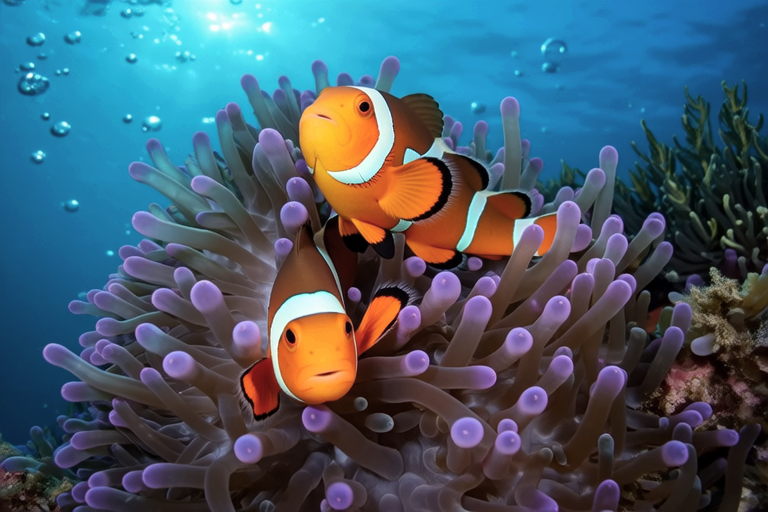
How Clownfish Survive in the Hostile Sea Anemone Environment
The ocean teems with life, from the smallest plankton to the largest whales. Among these diverse creatures, one of the most fascinating partnerships is that between the clownfish and sea anemones. This symbiotic relationship allows the clownfish to thrive in what would otherwise be a hostile environment, thanks to a series of remarkable biological and behavioral adaptations. In this article, we will delve into the intricacies of this unique partnership, exploring how clownfish manage to coexist with sea anemones and the mutual benefits they derive from each other.
The Symbiotic Relationship
The relationship between clownfish and sea anemones is a classic example of mutualism, where both species benefit from each other. Sea anemones are cnidarians, related to jellyfish and corals, known for their stinging tentacles. These tentacles are equipped with specialized cells called nematocysts, which release venomous harpoons to immobilize prey or deter predators. For most fish, coming into contact with these tentacles can be fatal. However, clownfish have evolved specific adaptations that allow them to live among these potentially deadly tentacles.
For the sea anemone, the clownfish serves as a bodyguard. By driving away potential predators, such as butterflyfish, which might otherwise feed on the anemone’s tentacles, the clownfish helps protect its host. Additionally, the clownfish’s constant movement around the anemone helps aerate the water, bringing fresh oxygen to the anemone’s tissues. The clownfish also feeds on small particles and parasites that may harm the anemone, thus contributing to its overall health.
In return, the clownfish benefits from the protection offered by the sea anemone. The anemone’s tentacles provide shelter and a safe haven for the clownfish, shielding it from larger predators. Moreover, the clownfish gains access to food scraps that the anemone doesn’t consume, ensuring a steady supply of nutrients.
Biological Adaptations
The ability of clownfish to live among sea anemones is primarily due to their unique biological adaptations. One of the most critical adaptations is the presence of a protective mucus layer on their skin. Unlike most fish, which trigger the release of nematocysts when they come into contact with sea anemones, clownfish have developed a mucus coating that prevents the anemone from recognizing them as prey. This mucus contains compounds that neutralize the anemone’s toxins, allowing the clownfish to move freely among the tentacles without being harmed.
Research has shown that the mucus coating of clownfish contains a specific sugar molecule, carbohydrin, which is believed to be responsible for this protection. This molecule mimics the structure of sugars found in the anemone’s own tissues, effectively tricking the anemone into not releasing its venom. Scientists have been able to replicate this effect in laboratory settings by applying a similar sugar coating to other fish, demonstrating that this adaptation is indeed the key to the clownfish’s survival.
Another important adaptation is the clownfish’s behavior. Clownfish have developed a cautious approach to their environment, often performing a dance-like ritual before fully entering the anemone. This behavior involves gently touching the anemone’s tentacles with different parts of their body, allowing the clownfish to acclimate to the anemone’s sting and gradually build up tolerance. Over time, the clownfish becomes accustomed to the anemone’s presence, reducing the risk of accidental injury.
Behavioral Adaptations
Beyond their biological adaptations, clownfish exhibit several behavioral traits that enhance their survival within the sea anemone environment. One notable behavior is their territoriality. Clownfish are highly territorial and will defend their anemone against intruders, including other clownfish. This behavior ensures that the anemone remains free from competition and provides a stable home for the resident clownfish.
Clownfish also display a unique mating behavior. They are sequential hermaphrodites, meaning they can change sex during their lifetime. Typically, the largest female in a group becomes dominant, while the second-largest fish transitions into a male. If the dominant female dies, the male will transform into a female, ensuring the continuation of the breeding pair. This reproductive strategy helps maintain the stability of the clownfish-anemone relationship, as it ensures that there is always a breeding pair available to produce offspring.
Moreover, clownfish are known for their vibrant colors and distinctive patterns. These features serve multiple purposes. Firstly, they act as a warning signal to potential predators, indicating that the clownfish is protected by the sea anemone. Secondly, these colors play a role in communication within the group, helping individuals recognize each other and maintain social hierarchies.
Scientific Insights
Recent studies have provided deeper insights into the mechanisms behind the clownfish-anemone relationship. Researchers have used advanced imaging techniques to observe the interactions between the two species at a microscopic level. These studies have revealed that the clownfish’s mucus coating not only prevents the anemone from stinging but also facilitates a chemical exchange between the two organisms. This exchange appears to strengthen the bond between the clownfish and the anemone, enhancing their mutual protection and nutrition.
Furthermore, genetic analyses have shed light on the evolutionary history of this relationship. It is believed that the clownfish and sea anemone partnership evolved over millions of years through a process of coevolution. As both species adapted to their shared environment, they developed complementary traits that allowed them to thrive together. This long-term evolution has resulted in a highly specialized and mutually beneficial relationship that is now crucial to the survival of both species.
Conclusion
The symbiotic relationship between clownfish and sea anemones is a testament to the complexity and adaptability of life in the ocean. Through a combination of biological and behavioral adaptations, clownfish have managed to overcome the challenges posed by the sea anemone’s stinging tentacles, creating a unique and mutually beneficial partnership. This relationship not only ensures the survival of both species but also highlights the intricate web of interactions that exists within marine ecosystems.
As we continue to explore and understand the natural world, it is essential to recognize the importance of these symbiotic relationships. They offer valuable lessons about cooperation, adaptation, and the delicate balance that sustains life in our oceans. By protecting these fragile ecosystems, we can help ensure the survival of these remarkable creatures and the countless other species that depend on them.
